
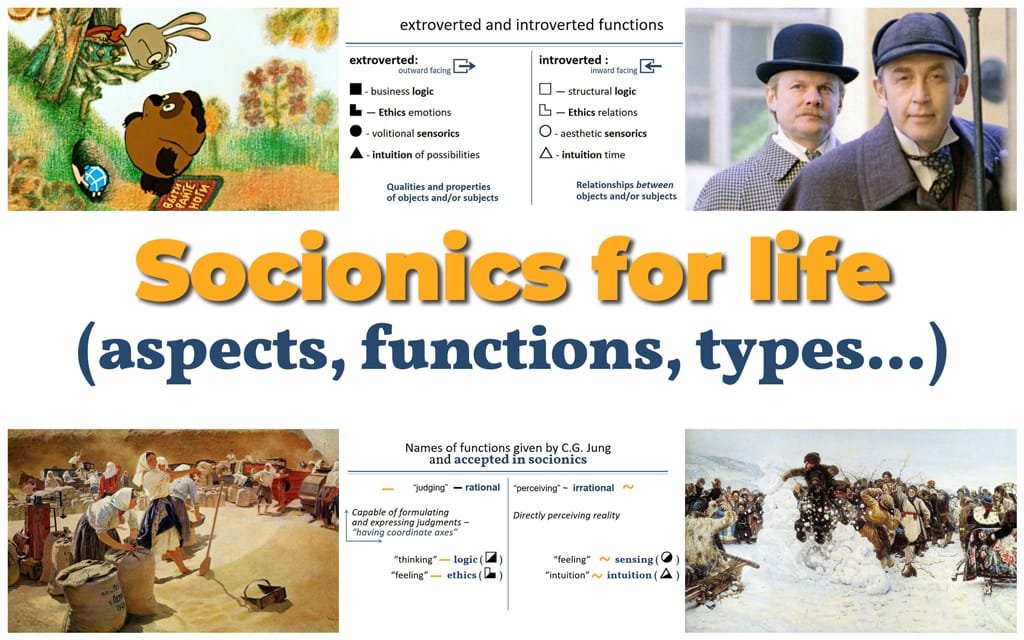
This is the first stage of the basic course in socionics. Just as white light, passing through a glass prism or reflecting in water droplets in the air, turns into a rainbow – is divided into 7 colors, all information perceived by the psyche is divided into8 information aspectsIn this course we will study information aspects, understand how they are related to each other, learn to detect them in different life situations, recognize them in people's speech and behavior.
You will learn:
- how does the logic of a businessman differ from the logic of a bureaucrat;
- how emotions differ from relationships and why sometimes you have to restrain your emotions in order to maintain a relationship;
- Why comfort is dangerous for warriors;
- what is intuition and can you trust it;
- Who is better off writing instructions and who is better off collecting facts.
In the psyche, for each informational aspect there is a “tool” – the psychicfunction. Each of us is fluent in only 2 of the 8 tools. These two functions are called strong functions of the socionic type – "program" and "creative". There are only 16 possible combinations of strong functions, so it turns out16 socionic types. But if we can’t immediately determine these functions, help will comeJung's signsAnd knowing the socionic type of a person, we can immediately say what he is strong in and what he is not so strong in; what kind of work he will do with ease and success, and what will be a burden to him.
You will find educational videos, examples and exercises with watching movie fragments. Watching videos and doing exercises you will learn:
- determine what information aspects can be used to describe a particular situation;
- understand which function a person is strong in, which is not so strong, and therefore, which tasks he solves easily and without errors, and what he needs help with;
- based on strong functions and/or Jung's characteristics, put forward a hypothesis about a person's socionic type;
- correctly distribute tasks between employees or choose an area of activity for yourself.
Lessons in this course:
- 01) History of Socionics
In the first lesson of the course, we will get acquainted with the history of socionics, learn the names of the scientists whose concepts formed the basis of socionics. A definition of socionics as a science will be given, what sections it consists of and where its approaches are applied.
- 02) 4 Axioms of Socionics
4 axioms of socionics - this is the briefest overview of its basic concepts, a concise statement of its principles and methods. Thanks to the 4 axioms, all sections of socionics are linked to each other, and the study and understanding of socionics becomes easier.
- 03) Logic: Structural vs. Algorithmic
From this lesson we begin to study information aspects. Each of the 4 macro aspects: logic, ethics, sensorics and intuition - is divided into 2 aspects - introverted and extroverted. In this lesson we will analyze in detail the 2 aspects into which the macro aspect of logic is divided on algorithmic logic and structural logic , study their semantics and learn to detect them in texts and phenomena of everyday life.
You will learn:
- what is the difference between the logic of a businessman and the logic of a bureaucrat,
- Who is better off writing instructions and who is better off collecting facts.
- 04) Ethics: Emotive vs. Relational
In this lesson, we will learn how emotions differ from relationships and why sometimes you have to restrain your emotions to maintain a relationship. We will examine in detail the two information aspects into which the macro aspect of ethics is divided - the ethics of emotions and the ethics of relationships - we will study their semantics and learn to detect them in texts and in everyday life.
- 05) Sensing: Volitional and Experiential
Why are sybarites dangerous for warriors? Who should be a commander and who should be a chef? You will learn about this and much more in this lesson. The macro aspect of sensing is divided into 2 aspects: volitional sensing and experiential sensing . In this lesson, we will examine these two aspects in detail, study their semantics and learn to detect them in texts and in everyday life phenomena.
- 06) Intuition: Potentiality vs. Temporal
Intuition is not a mystical property at all, but the same mental function as those we have already studied. In some life situations, intuition is absolutely necessary. In some cases, it helps to predict the development of events, in others - thanks to it, it is possible to discover hidden opportunities. The macro aspect of intuition is divided into 2 aspects: the intuition of opportunities and the intuition of time . In this lesson, we will analyze these two aspects in detail, study their semantics and learn to detect them in texts and in everyday life.
- 07) Rationality vs. Irrationality
We are not always able to determine the leading functions of the type, but we can find the predominant poles of Jung's traits: "rational-irrational", "extroverts-introverts", "logics-ethics", "intuitives-sensors". In this lesson, we will study the "rational-irrational" trait and learn how it is related to the rhythm of life and planning style.
- 08) Extraversion vs. Introversion
The concepts of extroversion and introversion were introduced by C. G. Jung and have become so firmly established in psychological and everyday life that they have even become the subject of numerous jokes and anecdotes. Socionics returns these terms to their original meaning. In this lesson, you will learn how extroverts differ from introverts (and this is NOT sociability at all!), what conditions they need for work and rest, and in what situations they are absolutely irreplaceable.
- 09) Logic vs. Ethics
We habitually sigh: "The mind and the heart are not in tune...". But someone in such a situation will think carefully and follow the considerations of the mind, and another chooses what the heart tells him. Logicians and ethicists belong to different poles in assessing the phenomena of the surrounding world and events in the world of people. The strength of the ethical is manifested in the attitude towards people, the strength of the logical is in the attitude towards the objective world. In this lesson we will consider in detail the difference between them.
- 10) Intuition vs. Sensing
A bird in the hand or two in the bush? Is the right choice always unambiguous? And is it possible to have both (and Winnie the Pooh will add: "You can - without bread")? Intuitives differ from sensory ones , first of all, in their approach to immediate reality and to the distant future. In this lesson, we will analyze their differences in detail, and not only in speech and text, but also in behavior and appearance.
- 11) Types and Jungian Dichotomies
The socionic type can be fully characterized either by 2 leading functions or by 4 poles of Jung's traits. Sometimes it is easier for us to understand/see the leading functions , in other cases we understand better the manifestation of theJung's traits. In this lesson we will learn to translate one description into another: knowing the 4 poles of Jung, write down the 2 leading functions of the TIM and vice versa - by the 2 leading functions of the type, determine the Jung signs.
- 12) Memo to the Manager
In this lesson we will be able to take a look at the entire socion - all 16 types - and understand how they are interconnected with each other, what serves as the basis for their specialization and cooperation. The functional name of the socionic type will become an important brick in the foundation of the image of the type that begins to take shape in your mind thanks to this course and which will later become an important tool for determining types. And the "Memo for the Manager" will help you today to correctly select people for this or that business and choose the right field of activity for yourself.
- The Final Lesson
Registration for the course occurs afterpaymentsin our store. Registered students can access course lessons via links on this page. For them, this page also displays the progress of the course. Another way to access your courses is through theMy Accountthe site.
 WhatsApp connect